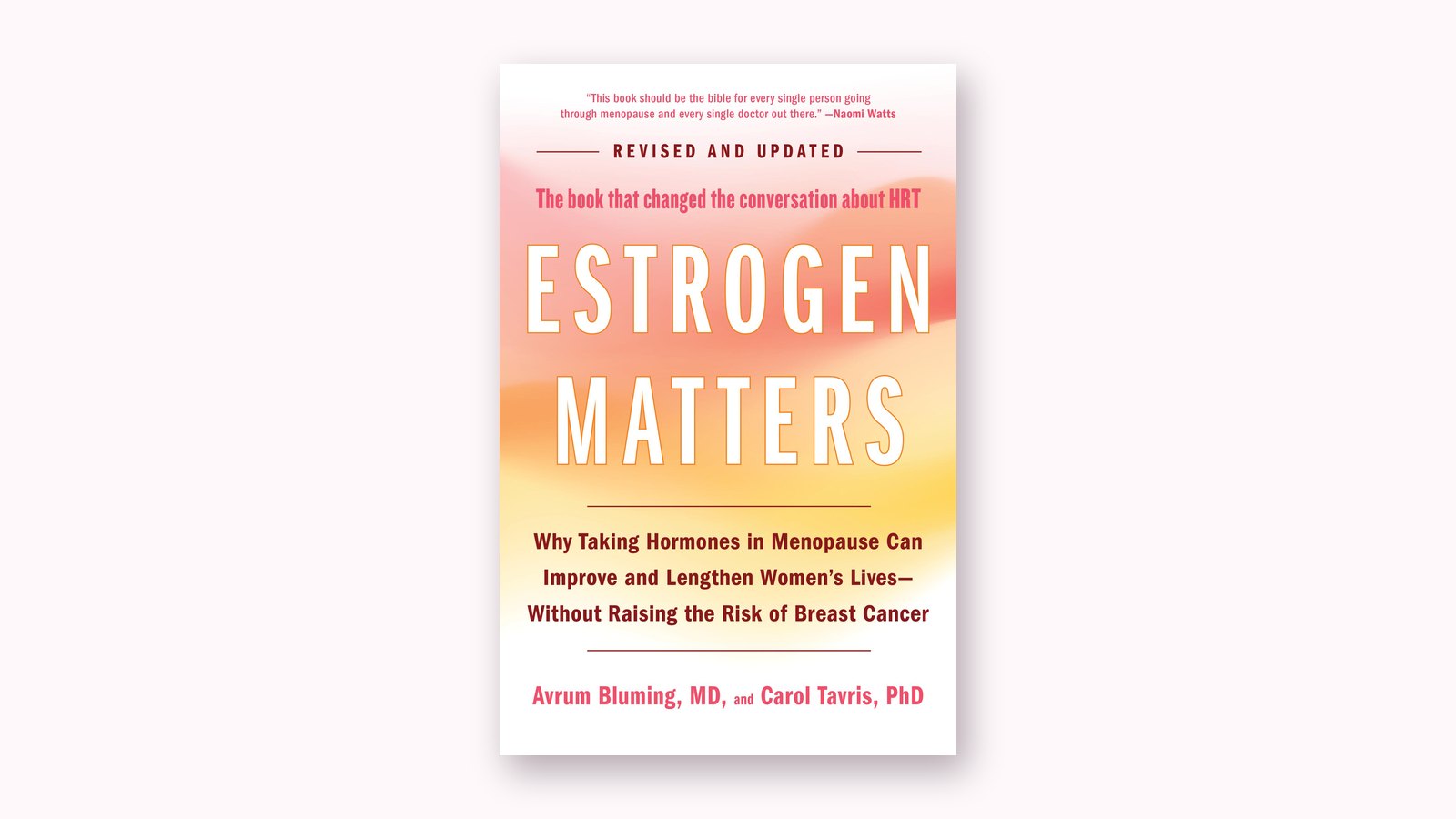
"The book that took apart the study that scared a generation off estrogen."
Estrogen Matters, by oncologist Avrum Bluming and social psychologist Carol Tavris, argues the 2002 hormone scare was a misreading of a flawed study, and that the rule shaping menopause care for 23 years was never a finding at all. Here's what the book actually says, and where I pushed back.
I picked up Estrogen Matters expecting to argue with it.
I’d spent a year deep in the menopause literature by then, and I’m suspicious of any book that puts a one-word promise on the cover. A retired oncologist telling women the breast-cancer fear was overblown, and that hormones can lengthen their lives? I expected cherry-picked studies and a tidy, comforting conclusion. I sat down ready to catch it.
That’s not what I found. What I found was a careful, heavily sourced argument that made me re-examine things I thought I already understood. So this is a review, not a sales pitch. I’ll tell you what the book gets right, what stopped me cold, and the places where I think it reaches past its own evidence.
Who wrote it, and why that matters
Avrum Bluming is an oncologist. He spent 40+ years at the intersection of cancer medicine and hormone research, and he kept prescribing HRT to breast cancer survivors while the rest of medicine ran the other way. He kept records.
He reviewed 26 studies on HRT in women who’d had breast cancer. Only one showed an increased risk of recurrence, and that was local recurrence at or near the original site, not the metastatic spread that actually kills people. Twenty-five out of twenty-six said it doesn’t make things worse. The one outlier had design problems he documents specifically. That’s the kind of detail that made me keep reading instead of arguing.
His co-author, Carol Tavris, is the social psychologist who wrote Mistakes Were Made (But Not By Me), one of the best books there is on how smart people and serious institutions dig in and defend a bad conclusion rather than admit they got it wrong. She brings that lens to this story, and it turns out to be the more important half of the book.
What the 2002 study actually studied
The whole scare traces back to July 2002, when the Women’s Health Initiative published results that emptied pharmacies within weeks. I’ve told that timing story in full in a separate piece on the 2002 fallout; here I want to stay with what Bluming and Tavris add to it.
Here’s what the WHI actually enrolled: women with an average age of 63, more than a decade past typical menopause, taking oral conjugated equine estrogen (made from pregnant mares’ urine, sold as Premarin) combined with a synthetic progestin, medroxyprogesterone acetate. Over 70% were overweight or obese. The researchers had deliberately excluded symptomatic women, which is to say the exact women who most often decide whether to start HRT. The population was older, heavier, and further from menopause than the women the resulting guidance would be applied to.
The reported relative risk increase for breast cancer was 26%. That sounds alarming. The absolute risk, the number that actually matters, worked out to fewer than one additional case per 1,000 women per year. Bluming and Tavris put that next to a risk we don’t warn anyone about: drinking two glasses of wine a night carries a larger breast-cancer risk than that. Wine doesn’t get a black box warning.
The benefits in the same study, less colorectal cancer and a real drop in hip fractures, barely made the coverage.
The rule that was never in the study
This is the part that genuinely stopped me.
The “lowest effective dose for the shortest possible time” guideline, the sentence that governed how doctors handled menopause for two decades, was never in the WHI paper. It isn’t a finding. It was written afterward, by professional bodies and the FDA, as a policy reaction to how the study was being read.
Sit with that. The single most consequential piece of menopause guidance of my lifetime wasn’t data. It was a flinch.
And here’s the book’s sharpest point. “Lowest dose, shortest time” is a sound principle for antibiotics, or chemotherapy, or any drug you give at levels the body doesn’t make on its own. Those are foreign chemicals with toxicity that climbs with dose and duration, so you use as little as you can for as short as you can. But estrogen isn’t foreign. It’s a hormone a woman’s body ran on continuously for 35 to 40 years. Cells across the body carry estrogen receptors because they evolved expecting it to be there. On this framing, postmenopause isn’t the baseline. It’s a deficiency state. The right question isn’t “what’s the minimum to mute hot flashes,” it’s “what level did this woman’s body actually run on, and how close to that can we safely get?”
The IVF number that reframes the whole risk conversation
The book points to one comparison I’d never seen made, and it’s hard to unsee.
During IVF, ovarian stimulation routinely pushes women to estradiol levels of 1,000 to 4,000 picograms per milliliter. Some egg donors hit 5,000 or 6,000. A menopausal woman on what used to be called “maximum” HRT dosing might reach 150 pg/mL.
Nobody panics about IVF. Fertility doctors monitor those levels, manage one specific mechanical risk, and send women home to have healthy pregnancies. Meanwhile medicine spent twenty years treating 100 pg/mL, less than a normal mid-cycle day before menopause, as dangerously high. A woman’s body ran at 200 to 600 pg/mL every month for three decades. The “risky” HRT level is a fraction of what she made on her own. The double standard is worth naming out loud.
Where I push back
I don’t want to hand you a book review that only nods along, because the book’s own strength is skepticism, and it would be strange to drop mine at the door.
Bluming and Tavris are on their firmest ground on breast cancer and cardiovascular risk, where they’ve got trial data and clear mechanisms. They’re on softer ground on the brain, and I think the book occasionally lets the optimistic reading run a little ahead of the evidence. The dementia and Alzheimer’s numbers it cites, roughly a 34% lower dementia risk and a 40% lower Alzheimer’s risk, come mostly from observational studies, not randomized trials, and observational data on hormone users carries a built-in “healthy user” bias that can manufacture protection that isn’t really there. The timing story is genuinely promising. It is not settled. I walk through why the strongest counter-study (WHIMS) doesn’t sink it, and why that still doesn’t prove the hopeful case, in a separate piece on the timing evidence.
None of that undoes the book. It sharpens it. The core claim, that a flawed study was misread and then hardened into a rule it never supported, holds up. I just want you reading it the way the authors would want, checking their work, not swallowing a conclusion because it’s the one you were hoping for.
What Tavris understands that most doctors don’t
The deeper mistake in this story wasn’t only scientific. It was sociological, and that’s Tavris’s whole territory.
Once the headlines landed and the warnings were issued and the guidelines were written, a correction became institutionally very hard. Admitting “lowest dose, shortest time” had no basis would mean admitting millions of women were undertreated for twenty years on bad guidance. Medical culture doesn’t move easily toward that kind of confession. Confirmation bias, professional identity, the sunk cost of published positions, the plain asymmetry between the courage it takes to say “I was wrong” and the comfort of waiting for someone else to say it first. Tavris has spent a career mapping exactly this, and watching her apply it to her own field is the part of the book I think about most.
The correction did finally come. After HHS and the FDA announced a class-wide removal in November 2025, the FDA formally approved the label changes in February 2026, calling the old boxed warnings “misleading.” The updated labels note that women who start HRT within ten years of menopause onset may lower their cardiovascular, cognitive, and fracture risk.
Twenty-three years.
What to do with this
Estrogen Matters isn’t a polemic. It’s a careful, sourced, readable case from a practicing oncologist and a research psychologist who pulled on this thread for years. The revised 2024 edition is updated with newer evidence, and it’s short. You can read it in a weekend.
Then, if you’re in your 40s or 50s and you’ve never had a real conversation about HRT with an actual menopause specialist, someone who follows the current literature rather than a general practitioner working off one lecture from 1995, that conversation is worth having. Bring your own questions. Read your own labs first. The label changes are recent enough that plenty of practitioners haven’t caught up, and walking in informed changes the whole exchange.
The title isn’t hyperbole. Estrogen mattered when your body was making it. On the evidence in this book, it still does.
Annette Thompson is 57, the founder of adoption.com, and a menopause advocate writing about evidence-based women’s health.
Sources
- Bluming A, Tavris C. Estrogen Matters: Why Taking Hormones in Menopause Can Improve Women’s Well-Being and Lengthen Their Lives, Without Raising the Risk of Breast Cancer. Little, Brown Spark, 2018; revised and updated edition 2024. The book is the source for the “lowest dose, shortest time” critique, the IVF estradiol comparison, and the deficiency-state framing.
- Tavris C. Mistakes Were Made (But Not By Me). Harcourt, 2007. Tavris’s earlier book on how institutions defend bad conclusions.
- Rossouw JE et al., JAMA 2002: Risks and Benefits of Estrogen Plus Progestin in Healthy Postmenopausal Women. The original WHI estrogen-plus-progestin results: breast cancer hazard ratio 1.26, an absolute increase of about 8 cases per 10,000 women per year, alongside reduced colorectal cancer and reduced hip fractures. This is the arm the “26%” figure comes from.
- Bluming A, The Cancer Journal 2022: Hormone Replacement Therapy After Breast Cancer. Bluming’s review of the studies on HRT in breast cancer survivors.
- Holmberg L et al., The Lancet 2004: HABITS trial. The one outlier trial, which found increased local or contralateral recurrence but no increase in breast cancer death.
- Salpeter SR et al., J Gen Intern Med 2006: Coronary Heart Disease Events Associated With Hormone Therapy in Younger and Older Women. A 32% reduction in coronary heart disease events (odds ratio 0.68) in women who start within about ten years of menopause, with no benefit in older starters.
- Rossouw JE et al., JAMA 2007: Postmenopausal Hormone Therapy and Risk of Cardiovascular Disease by Age and Years Since Menopause. The WHI timing analysis behind the window that matters.
- Manson JE et al., Menopause 2020: The Women’s Health Initiative Trials of Menopausal Hormone Therapy, Lessons Learned.
- Yaffe K et al., JAMA 1998: Estrogen Therapy in Postmenopausal Women and Cognitive Function. Observational meta-analysis finding roughly a 29% lower dementia risk among estrogen users, with the authors flagging heterogeneity.
- LeBlanc ES et al., JAMA 2001: Hormone Replacement Therapy and Cognition. Systematic review reporting about a 34% lower dementia risk in observational data.
- Shumaker SA et al., JAMA 2003: Estrogen Plus Progestin and the Incidence of Dementia (WHIMS). The trial that found cognitive harm, in women aged 65 and older, averaging about 71.
- Chlebowski RT et al., JAMA 2020: Menopausal Hormone Therapy and Breast Cancer Incidence and Mortality. Long-term WHI follow-up: estrogen-alone lowered breast cancer incidence and mortality while estrogen-plus-progestin raised it.
- Anderson GL et al., The Lancet Oncology 2012: Conjugated Equine Oestrogen and Breast Cancer. The estrogen-alone arm: reduced breast cancer incidence and mortality.
Keep reading


Get the research, not the reassurance.
Every issue is free and every claim is sourced. Join women 40+ who are reading the science, asking better questions, and refusing to accept "it's just aging" as an answer.
Subscribe free on Substack